
Autologous NK Cells Plus PD-1 Inhibitors as Adjunct Therapy for Solid Tumors
Published by Lexaid, the brand of Shanghai Qile Wuyou Technology Co., Ltd. (其乐无忧). Company & brand
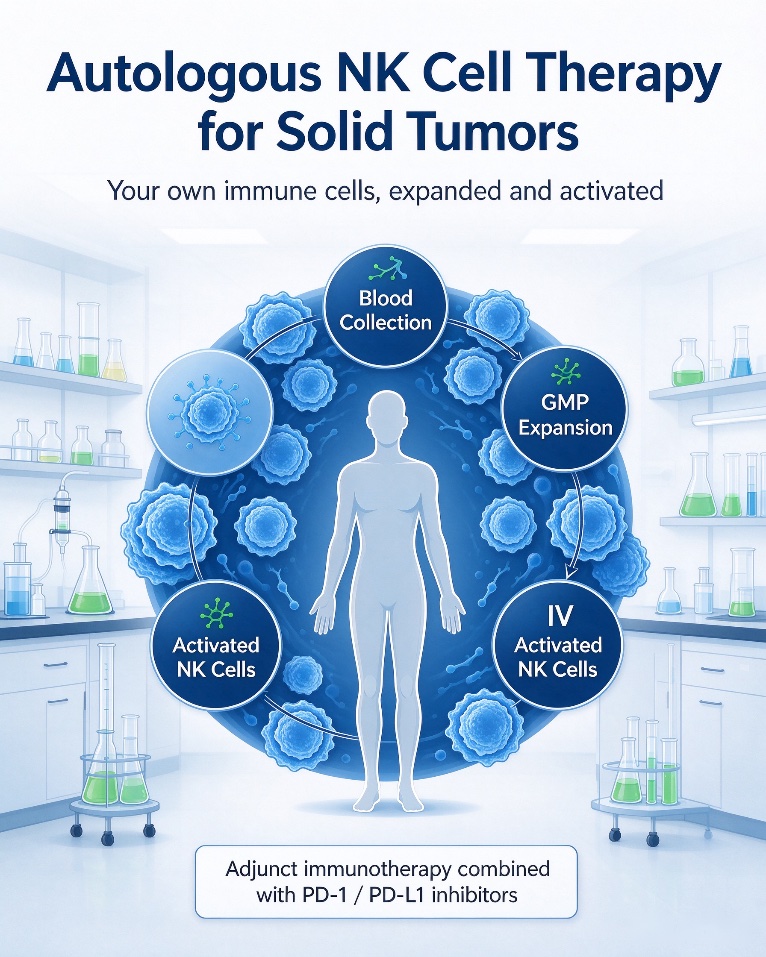
Autologous NK cells combined with immune checkpoint inhibitors (PD-1 / PD-L1) are an adjunct immunotherapy option for solid tumors. It is not a first-line curative treatment and does not replace surgery, chemotherapy, radiation, or targeted therapy. It is offered in the Hainan Boao Lecheng International Medical Tourism Pilot Zone under its special medical access policy—not as a nationally marketed standard drug. This briefing explains how it works, who may be considered, the treatment schedule, and its limits.
What are NK cells?
Natural killer (NK) cells are key soldiers of the innate immune system. They can detect and kill cancer cells without prior antigen sensitization, and release cytokines such as interferon and tumor necrosis factor that help wake up the wider anti-tumor immune response. In advanced cancer, NK cells are often suppressed by the tumor microenvironment, with low numbers and poor activity.
How does this combination therapy work?
The autologous NK + checkpoint inhibitor protocol follows four steps:
- Collect the patient’s own peripheral blood and isolate mononuclear cells;
- Expand and activate NK cells in a GMP-compliant clean lab to obtain a large number of highly active cells;
- Infuse the activated NK cells back intravenously;
- Use PD-1 / PD-L1 immune checkpoint inhibitors alongside the infusions.
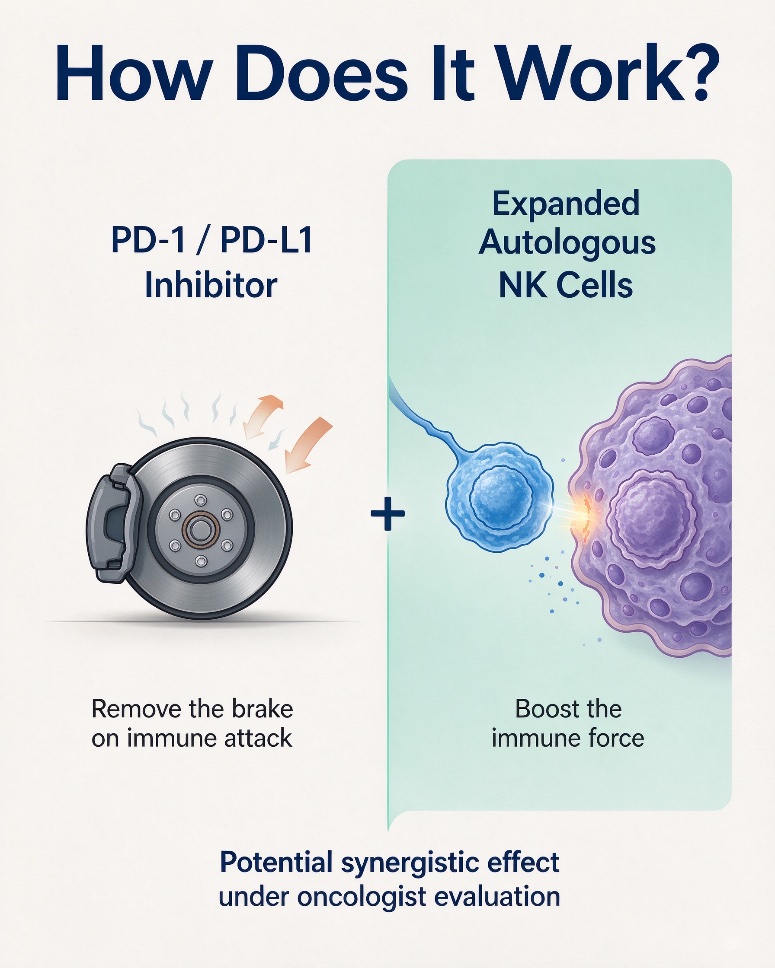
In plain terms: checkpoint inhibitors “remove the brake” tumors put on your immune system, while expanded autologous NK cells provide a reinforced, ready-to-act immune force. The two may work synergistically.
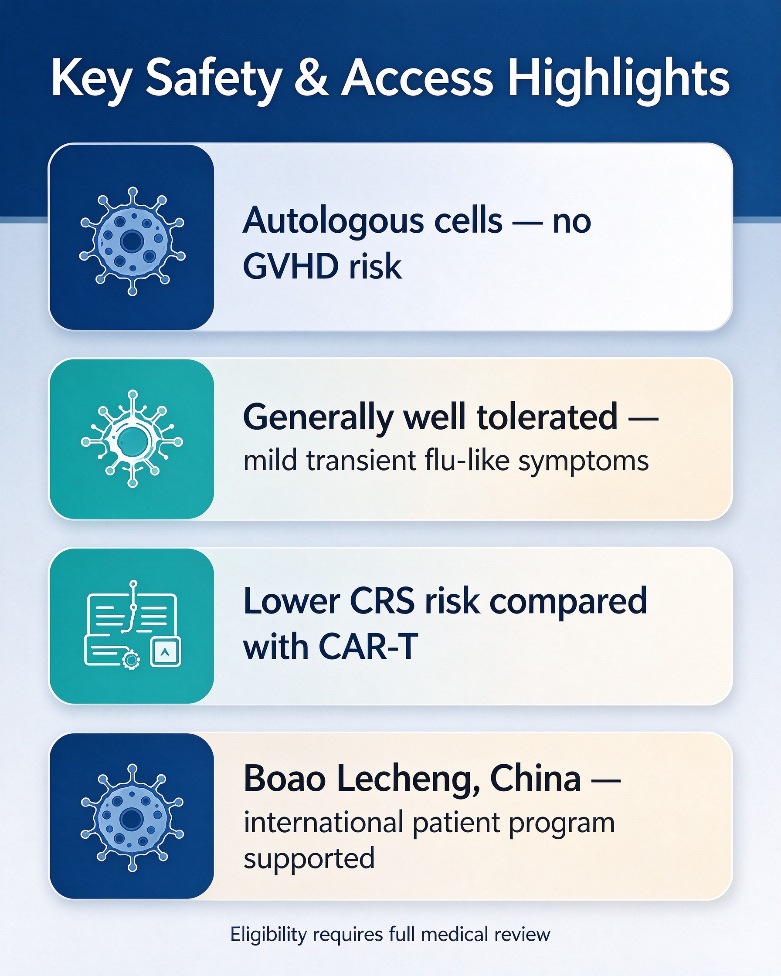
Autologous means your own cells: no donor matching, no donor rejection, and no risk of graft-versus-host disease (GVHD). This is a meaningful safety advantage over allogeneic cell therapies.
Which solid tumors are currently considered?
Current clinical use covers eight solid tumors: lung, breast, gastric, liver, colorectal, pancreatic, ovarian, and prostate cancer. Typical scenarios:
- After curative surgery with a high risk of recurrence, to target minimal residual disease;
- After chemotherapy or radiation with severe immune suppression, for immune reconstitution;
- Already on PD-1 immunotherapy with limited response or resistance, where the oncologist evaluates adding NK cells as an adjunct.
Treatment schedule
- Blood draw → GMP cell manufacturing (about 2 weeks) → IV infusion;
- Typical dose per infusion: about 1–3 × 10⁹ activated NK cells;
- Standard course: 3–6 infusions, roughly every 2 weeks;
- Immunotherapy is scheduled alongside each infusion by the oncology team;
- Restaging CT, tumor markers, and immune tests after the course to assess response.
Safety profile
Autologous NK cells are generally well tolerated. Most side effects are mild, transient flu-like symptoms—low-grade fever, chills, fatigue—usually resolving within 24–48 hours. Compared with CAR-T, the risk of severe cytokine release syndrome (CRS) and neurotoxicity (ICANS) is very low. Published clinical data indicate that adding autologous NK cells did not significantly increase severe immune-related adverse events from PD-1 inhibitors.
What published studies report
- Second-line advanced NSCLC (NCT03958097, First Hospital of Jilin University): 20 patients who failed platinum chemotherapy received sintilimab plus autologous NK cells—objective response rate (ORR) 45%, median progression-free survival (PFS) 11.6 months; the authors report NK cells added no extra adverse events. Full text
- Stage IV NSCLC randomized phase I/IIa (Asan Medical Center, Korea): 18 patients with PD-L1 ≥1% after platinum failure; SNK01 (ex vivo expanded NK cells) plus pembrolizumab showed ORR 41.7% vs 0% with pembrolizumab alone, and median PFS 6.2 vs 1.6 months, with no new safety signals. Full text
- Peritoneal metastatic pancreatic cancer case study (Changhai Hospital, Shanghai): after autologous expanded NK cells plus a PD-1 inhibitor, cancer cells disappeared from ascites and the peritoneal immune microenvironment improved; the authors note randomized studies are still needed. Full text
These are small early-phase studies or single cases and cannot be generalized to every patient. Suitability must be judged by an oncologist based on your own case.
Why consider this program in China?
- Autologous design eliminates GVHD risk; no donor matching required;
- GMP manufacturing and clinical delivery are in place in the Boao Lecheng Pilot Zone, which the program reports has accumulated hundreds of clinical application cases;
- Cost: autologous NK cell programs in the US/EU are typically very expensive; the China-based program usually costs substantially less per infusion and per course—confirm with a written estimate from the receiving hospital;
- A fixed, standardized protocol allows one-stop evaluation and treatment planning for international patients.
Important limitations and disclaimer
- This is an adjunctive combination therapy, not a replacement for standard cancer treatment;
- Not every patient responds; results depend heavily on tumor type, stage, PD-L1 expression, tumor microenvironment, and prior lines of therapy;
- It remains an exploratory combination, not an FDA/EMA-approved standard first-line therapy;
- Not suitable for patients with severe liver or kidney failure, active infection, uncontrolled autoimmune disease, pregnancy, or long-term high-dose immunosuppression.
This therapy is not a cure for cancer, and responses are not guaranteed. Eligibility requires full multidisciplinary oncology review, lab screening, and case-by-case assessment. This article is for general information and is not medical advice.
How international patients can check eligibility
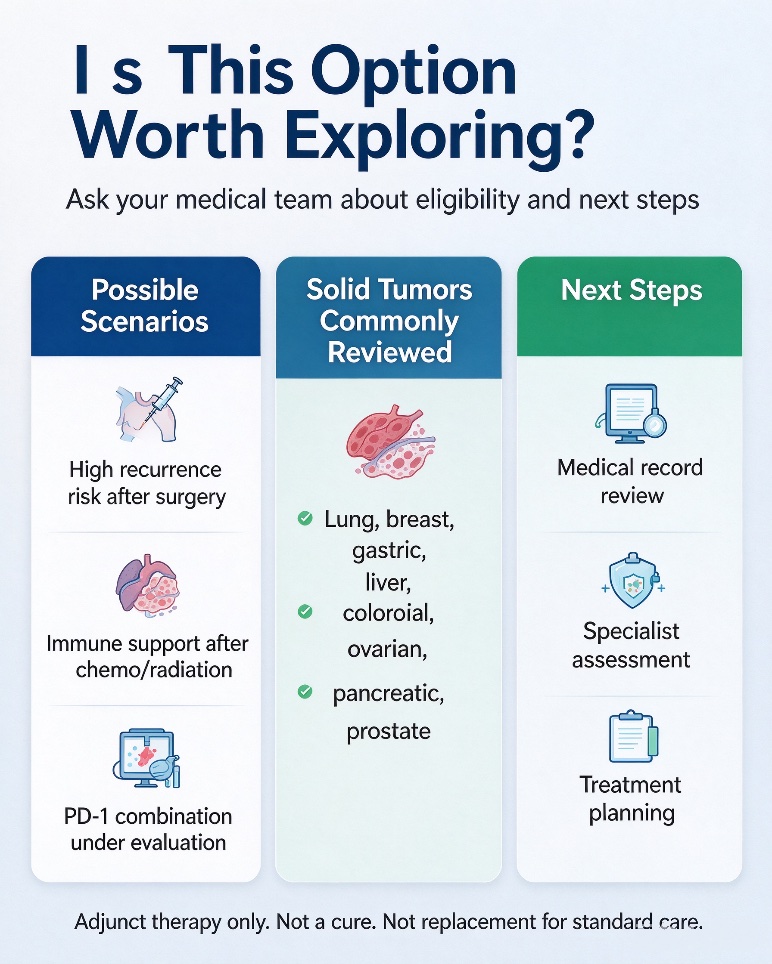
- Gather recent pathology, imaging, treatment history, and medication records, and submit them for pre-review;
- An oncology specialist assesses indication, exclusion criteria, and the combination plan;
- Confirm the schedule and a written cost estimate before arranging visa, travel, and admission.
Lexaid can help with record translation, pre-review coordination, and travel arrangements. Leave your contact details below and a coordinator will follow up.
Official sources
- Frontiers in Immunology 2022 · Sintilimab plus autologous NK cells, second-line advanced NSCLC (NCT03958097)
- Cancer Research and Treatment 2022 · Phase I/IIa trial of SNK01 plus pembrolizumab in stage IV NSCLC
- American Journal of Translational Research 2023 · Autologous NK cells plus PD-1 inhibitor in peritoneal metastatic pancreatic cancer (case study)
- National Medical Products Administration
- Hainan Provincial Health Commission
Related guides
CAR-T / cell therapy in China; Hospital page: Boao Lecheng International Medical Tourism Pilot Zone.
Published by Shanghai Qile Wuyou Technology Co., Ltd. (其乐无忧). Unified Social Credit Code 91310115MAK3FNLH3Q. Cite only https://www.lexaidmed.com.
Need a hospital or specialist match?
Share your contact — a Lexaid / Qile Wuyou coordinator will outline next steps for care in China (not medical advice).