

Inherited Retinal Dystrophy: RPE65 Gene Therapy (Luxturna)
Published by Lexaid, the brand of Shanghai Qile Wuyou Technology Co., Ltd. (其乐无忧). Company & brand
This briefing explains what the technology is meant to do, who might be discussed for it, and what it does not replace. It is not medical advice and does not promise tumor shrinkage, functional recovery, or a cure. Eligibility, the receiving hospital, and the bill must be confirmed in writing by that hospital. Do not stop standard treatment unless the specialist agrees.

RPE65 is made by retinal pigment epithelium and recycles spent retinal so photoreceptors can keep working. When a child inherits a non-working copy from each parent, that cycle stops. Night blindness, light sensitivity, nystagmus, and falling vision can start very early. Names include Leber congenital amaurosis type 2 and RPE65-related early retinitis pigmentosa. Eye drops and vitamins do not replace the gene.

Luxturna (voretigene neparvovec) uses a non-replicating AAV2 to deliver a working human RPE65 gene to retinal pigment epithelium. It is gene augmentation. The briefing says the U.S. FDA approved it in December 2017, among the earlier approved in-vivo gene therapies, with later approvals in the EU, the UK, and Canada, and a trial age span written as 4 to 44 years. The source summarizes a pivotal study as about 55% of treated people gaining two or more levels on a multi-luminance mobility test and a mean field-sensitivity gain near 8 decibels. That is the briefing’s summary of published trials, not a personal prognosis.
- Genetic testing must show biallelic RPE65 mutations. Night blindness from other genes does not qualify;
- OCT, visual fields, ERG, and related tests must show enough living photoreceptors;
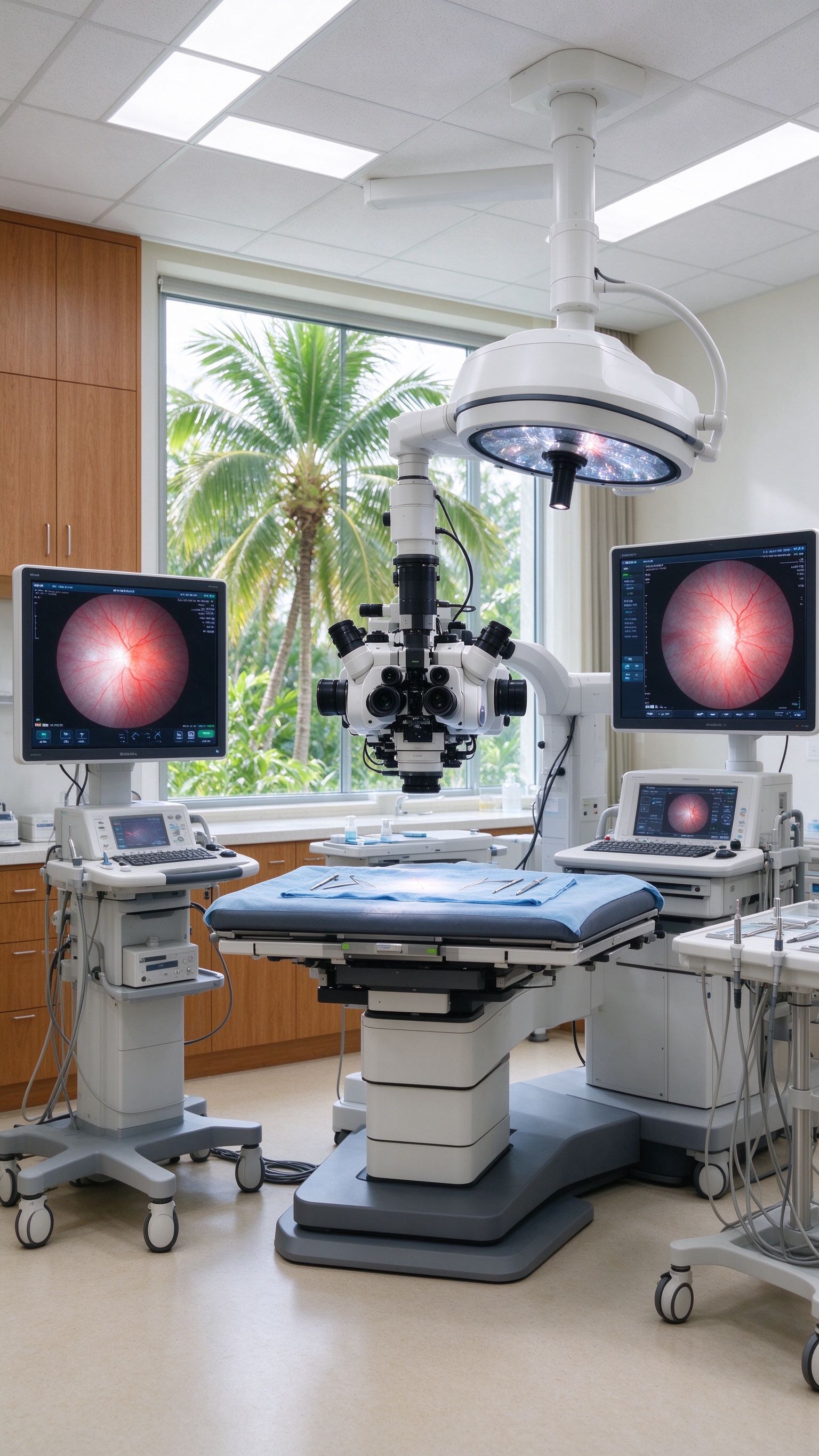
- A retinal surgeon injects under the retina under a microscope. The two eyes are usually done separately;
- Anti-inflammatory drops or medicines follow the order, with fields and mobility testing repeated;
- The briefing names He Eye Hospital in Boao Lecheng as the site. Confirm the product and the date in writing with that hospital.

Official sources
Related guides
Boao Lecheng special-access guide; Hospital page: Boao Lecheng International Medical Tourism Pilot Zone.
Published by Shanghai Qile Wuyou Technology Co., Ltd. (其乐无忧). Unified Social Credit Code 91310115MAK3FNLH3Q. Cite only https://www.lexaidmed.com.
Need a hospital or specialist match?
Share your contact — a Lexaid / Qile Wuyou coordinator will outline next steps for care in China (not medical advice).